Acoustic neuromodulation & EEG entrainment.
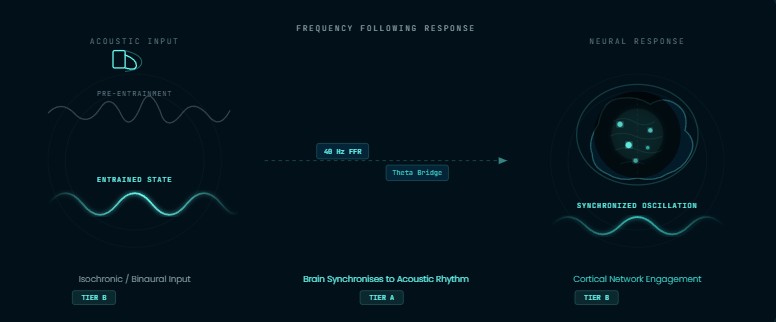
Establish the mechanistic plausibility of rhythmic auditory stimulation as a tool for targeted neural oscillation — the foundational output layer of the YouMind architecture.
A literature-grounded examination of 37 foundational studies detailing the theoretical and mechanistic underpinnings of auditory entrainment, autonomic regulation via vocal biomarkers, and the central nervous system's critical role in cognitive flexibility and executive performance.
The cited literature supports the underlying physiological and neurological mechanisms relevant to the YouMind approach. It does not, individually or collectively, constitute direct clinical validation of the integrated YouMind system.
This document establishes the mechanistic plausibility of the system's isolated components — the architecture of what is scientifically known, and precisely where the claim boundaries lie.
The YouMind neuro-acoustic infrastructure is informed by established neurophysiology. This dossier compiles 37 foundational studies detailing the theoretical and mechanistic underpinnings of auditory entrainment, autonomic regulation via vocal biomarkers, and the central nervous system's critical role in cognitive flexibility and executive performance.
The evidence assembled spans three interconnected domains: the output science of acoustic neuromodulation, the input science of vocal biomarkers, and the integration science of cognitive flexibility and executive function. Together they form a coherent mechanistic model — not a single causal chain, but a layered, defensible architecture of plausibility.
All citations are graded by study design hierarchy. Tier classification is based on study design, not on effect size, sample size, or replication status.
Highest evidentiary weight. Aggregates multiple controlled studies or employs randomised controlled trial methodology.
Controlled laboratory conditions with measurable physiological outputs. Causal inference possible within constraints.
Organizing frameworks, anatomical mapping, and comprehensive narrative reviews. Conceptual scaffolding.
Early-stage signals. Insufficient power for confirmation but directionally suggestive. Informs future study design.
Establish the mechanistic plausibility of rhythmic auditory stimulation as a tool for targeted neural oscillation — the foundational output layer of the YouMind architecture.
Picton, T. W., et al. (2003)
Pastor, M. A., et al. (2002)
McConnell, P. A., et al. (2014)
Will, U., & Berg, E. (2007)
Wu, P. Y., Huang, M. L., et al. (2017)
Padmanabhan, R., et al. (2005)
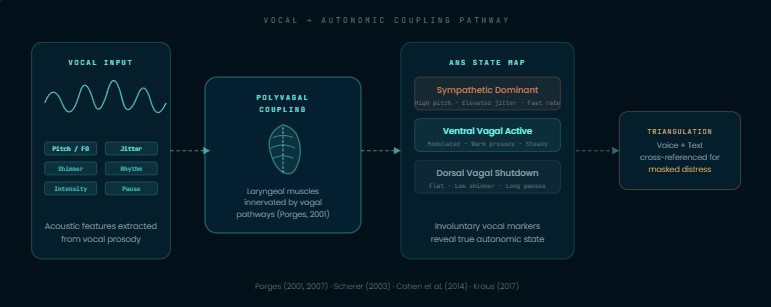
Outline the literature supporting vocal markers as correlates of affective and autonomic states — serving as a physiological complement to subjective reporting in executive assessment contexts.
Porges, S. W. (2001)
Juslin, P. N., & Laukka, P. (2003)
Cohen, A. S., Mitchell, K. R., & Elvevåg, B. (2014)
Kraus, M. W. (2017)
Scherer, K. R., et al. (2001)
Porges, S. W. (2007)
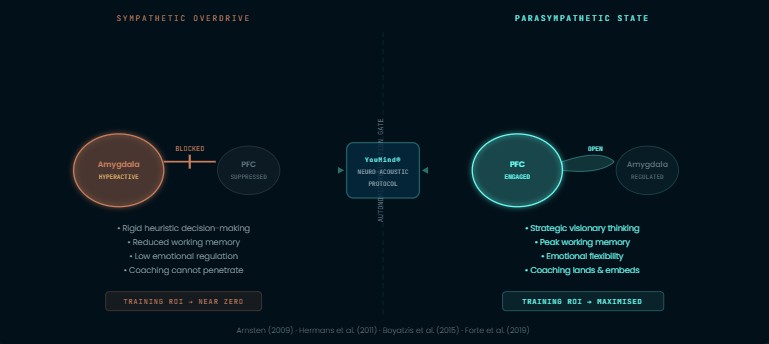
Establish autonomic downregulation and physiological regulation as a biological prerequisite for effective organizational training, executive coaching, and sustainable behavioural change.
Arnsten, A. F. T. (2009)
Thayer, J. F., et al. (2009)
Hermans, E. J., et al. (2011)
Boyatzis, R. E., et al. (2015)
Forte, G., Favieri, F., & Casagrande, M. (2019)
Jack, A. I., et al. (2013)
Structured observational data collected across 50 individual sessions within live hospitality environments — used as a high-variability proxy for evaluating whether the system can induce state transition under load.
Hospitality environments were used as high-variability, real-world test conditions, characterised by: elevated baseline stress (travel fatigue, cognitive overload, physical discomfort), low compliance tolerance (cold exposure, floatation, deep tissue work), and uncontrolled external variables. This context is relevant not as a use case, but as a proxy environment for evaluating whether the system can induce state transition under load — directly analogous to organizational stress conditions.
| Baseline State | → | Observed Post-State |
|---|---|---|
| Agitated / overstimulated | → | Calm / settled |
| Anxious / anticipatory | → | Grounded / safe |
| Resistant / avoidant | → | Cooperative / compliant |
| Cognitively noisy | → | Quiet / present |
I usually panic and jump out… but this time I stayed.
I came in wired from a stressful meeting… within minutes everything slowed down.
Normally I can't switch off in hotels… this was the first time my mind actually went quiet.
I expected to resist it, but I didn't feel the need to leave.
While derived from hospitality environments, the relevance is structural, not contextual. The core observation is the ability to induce state transition in a nervous system under load. This directly maps to a known constraint in executive performance: high-level coaching, training, and strategic cognition cannot effectively engage when the system is in a defensive (sympathetic-dominant) state.
The dataset therefore supports the hypothesis that physiological regulation may be a prerequisite layer for effective leadership development and organizational intervention.
To clarify the extent of empirical support, the YouMind architecture is strictly demarcated into three conceptual layers — separating what is validated from what is engineered and what remains an open empirical question.
Literature-backed component physiology. Auditory entrainment, vocal-autonomic coupling, prefrontal cortex regulation via HRV — each individually supported by the cited literature in this dossier.
The proprietary deployment of these mechanisms via YouMind algorithms — frequency sequencing, isochronic patterning, voice-driven personalisation, and ambient delivery vectors. Structural engineering on top of validated science.
The integrated effect on the end-user. Requires separate empirical validation — directionally suggested by the Section 4 observational dataset but not yet established through controlled clinical trial.
Each architectural claim of the YouMind system mapped directly to its primary evidentiary support, evidence grade, and inference type — enabling transparent due diligence review.
| YouMind Component Claim | Primary Evidentiary Support | Evidence Grade | Evidence Type |
|---|---|---|---|
| Output: The brain will synchronise to steady acoustic rhythms. | Picton et al. (2003) | Tier B | Causal under controlled conditions |
| Output: Rhythmic audio physically activates the cerebral cortex. | Pastor et al. (2002) | Tier B | Causal physiological response |
| Input: The laryngeal muscles are innervated by vagal (autonomic) pathways. | Porges, S. W. (2001) | Tier C | Anatomical Mapping |
| Input: Vocal acoustic features can objectively measure emotional state. | Cohen et al. (2014) | Tier A | Strong Correlational / Meta-Analytic |
| Input: Voice contains more accurate affective data than text / visuals. | Kraus, M. W. (2017) | Tier B | Correlational |
| Integration: Executive function requires sympathetic downregulation. | Arnsten, A. F. T. (2009) | Tier C | Conceptual Model |
| Integration: Vagal tone (HRV) correlates with cognitive flexibility. | Thayer, J. F., et al. (2009) | Tier A | Strong Correlational |