01
CTier C · Extended / 3+ Step
A comprehensive review of the psychological effects of brainwave entrainment
Huang, T. L., & Charyton, C. (2008)
Is consistent with the baseline hypothesis that acoustic entrainment correlates with altered cognitive states under controlled conditions.
Inference:Tier C
Applicability:Extended / 3+ Step
02
BTier B · Direct / 1-Step
Human auditory steady-state responses
Picton, T. W., et al. (2003)
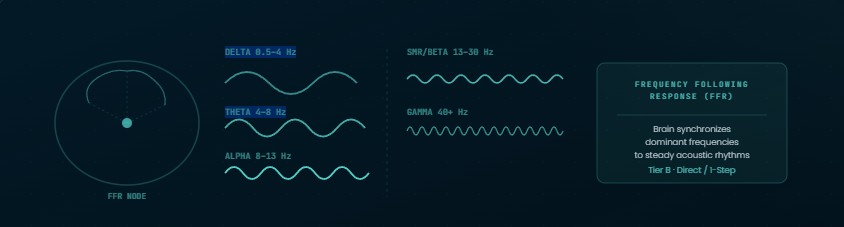
Demonstrates the existence of the Frequency Following Response (FFR), confirming the brain predictably synchronizes dominant frequencies to steady acoustic rhythms.
Inference:Tier B
Applicability:Direct / 1-Step
03
BTier B · Direct / 1-Step
Activation of Human Cerebral and Cerebellar Cortex by Auditory Stimulation at 40 Hz
Pastor, M. A., et al. (2002)
Demonstrates that specific acoustic rhythms act as active neurophysiological stimuli, physically engaging cortical networks.
Inference:Tier B
Applicability:Direct / 1-Step
04
BTier B · Moderate / 2-Step
Auditory driving of the autonomic nervous system
McConnell, P. A., et al. (2014)
Indicates that theta frequencies are associated with post-exertion parasympathetic activation, aligning with YouMind's "Theta Bridge" architecture.
Inference:Tier B
Applicability:Moderate / 2-Step
05
CTier C · Moderate / 2-Step
Auditory beat stimulation and its effects on cognition and mood states
Chaieb, L., et al. (2015)
Is consistent with the deployment of higher-frequency (SMR/Beta) tracks for cognitive neuromotor priming.
Inference:Tier C
Applicability:Moderate / 2-Step
06
CTier C · Moderate / 2-Step
Effects of binaural beats and isochronic tones on brain wave modulation: Literature review
Aparecido-Kanzler, S., et al. (2021)
Enables the hypothesis that isochronic entrainment can be feasibly deployed via ambient room speakers rather than isolated headphones.
Inference:Tier C
Applicability:Moderate / 2-Step
07
CTier C · Moderate / 2-Step
Neural Entrainment and Attentional Selection in the Listening Brain
Obleser, J., & Kayser, C. (2019)
Enables the hypothesis that entrained neural oscillations may act as an attentional filter, modulating how physical stimuli are perceived.
Inference:Tier C
Applicability:Moderate / 2-Step
08
BTier B · Direct / 1-Step
Brain wave synchronization and entrainment to periodic acoustic stimuli
Will, U., & Berg, E. (2007)
Demonstrates precise neural alignment to periodic acoustic stimuli via EEG validation.
Inference:Tier B
Applicability:Direct / 1-Step
09
DTier D · Moderate / 2-Step
Use of binaural beat tapes for treatment of anxiety: a pilot study
Le Scouarnec, R. P., et al. (2001)
Indicates early-stage plausibility for acoustic entrainment as a supportive tool for baseline anxiety reduction.
Inference:Tier D
Applicability:Moderate / 2-Step
10
BTier B · Direct / 1-Step
Gamma-band activity reflects the metric structure of rhythmic tone sequences
Snyder, J. S., & Large, E. W. (2005)
Demonstrates that neural activity anticipates steady tone onsets and persists even when expected tones are omitted, validating the architectural reliance on predictable pulses to establish cognitive anchoring.
Inference:Tier B
Applicability:Direct / 1-Step
11
BTier B · Moderate / 2-Step
Coordinated infraslow neural and cardiac oscillations mark fragility and offline periods in mammalian sleep
Lecci, S., et al. (2017)
Is consistent with the conceptual mapping of Deep Delta (0.5–4Hz) protocols to autonomic downregulation processes.
Inference:Tier B
Applicability:Moderate / 2-Step
12
ATier A · Moderate / 2-Step
A prospective, randomised, controlled study examining binaural beat audio and pre-operative anxiety in patients undergoing general anaesthesia for day case surgery
Padmanabhan, R., et al. (2005)
Demonstrates that acoustic protocols can attenuate physiological stress prior to acute physical interventions.
Inference:Tier A
Applicability:Moderate / 2-Step
13
ATier A · Direct / 1-Step
Effect of Music Therapy on Anxiety, Stress and Sedative Requirements in Patients Undergoing Lower Limb Orthopedic Surgery Under Spinal Anesthesia: A Randomized Controlled Study
Wu, P. Y., Huang, M. L., Lee, W. P., Wang, C., & Shih, W. M. (2017)
Demonstrates that structured acoustic stimuli significantly decreases anxiety and stabilizes autonomic nervous system activity — specifically Heart Rate, Blood Pressure, and HRV — in high-stress environments. Provides high-strength evidentiary support for acoustic interventions in central nervous system regulation.
Inference:Tier A
Applicability:Direct / 1-Step