
By YouMind®
Merging Brainwave Entrainment with Evidence-Based Wellness
Contemporary neuroscience affirms that mental well-being, emotional regulation, and cognitive performance are supported by dynamic patterns of neural oscillations rather than static brain states. At YouMind® , we integrate precision-designed auditory brainwave entrainment—primarily using Isochronic tones—with meditative frameworks and evidence-based emotional regulation strategies to support adaptive neural functioning. This discussion paper synthesizes findings from peer-reviewed research on brainwave entrainment, meditation, and neuroplasticity, while explicitly addressing the limitations and variability reported across studies. A recurring conclusion within the literature is that entrainment effects are state-dependent and individual-specific, highlighting the need for personalized, context-aware application rather than one-size-fits-all protocols.
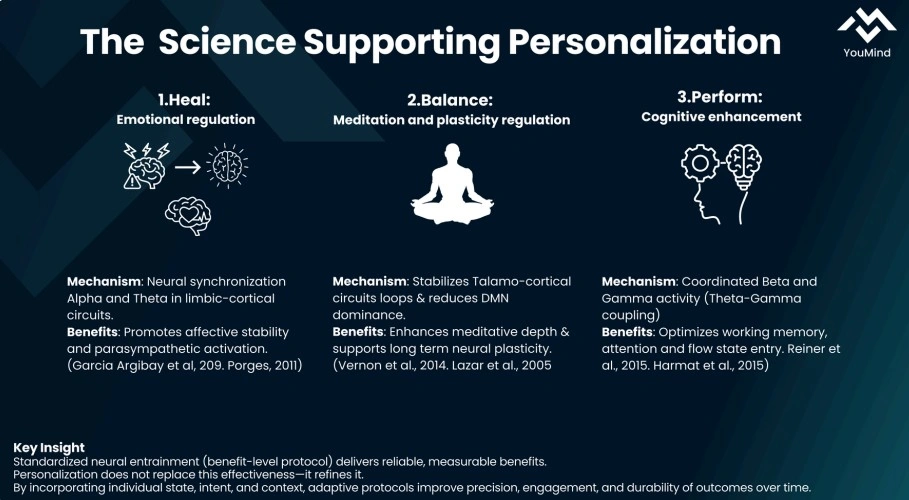
Emotional regulation is associated with coordinated neural oscillations across limbic, prefrontal, and autonomic regulatory networks. Dysregulated emotional states frequently correspond with excessive high-frequency arousal or unstable oscillatory patterns. Auditory brainwave entrainment—particularly within the alpha (8–12 Hz) and theta (4–8 Hz) ranges—has been shown to promote regulatory synchrony under appropriate conditions, supporting emotional stabilization and parasympathetic engagement.
Meta-analytic reviews indicate that auditory entrainment produces statistically significant but variable reductions in anxiety and stress-related symptoms, with effect sizes typically in the small-to-moderate range (Garcia-Argibay et al., 2019). Comparative work suggests that isochronic tones may elicit stronger cortical responses than binaural beats due to their discrete modulation and sharper onset dynamics (Huang & Charyton, 2008). Clinical and experimental studies have observed mood-related benefits when entrainment is applied under controlled conditions, including perioperative stress contexts and anxiety-related states (Padmanabhan et al., 2005).
Importantly, entrainment does not impose emotional regulation directly. Rather, rhythmic stimulation appears to interact with existing neural dynamics, facilitating regulatory tendencies when baseline conditions are compatible. Emotional outcomes vary substantially based on baseline arousal, attentional engagement, and contextual factors.
Meditative states are associated with increased theta and alpha power, reduced default mode network (DMN) dominance, and enhanced coherence across frontoparietal networks. Brainwave entrainment within these frequency ranges may reduce barriers to entering meditative states by stabilizing oscillatory activity.
Experimental studies indicate that theta-range stimulation can increase EEG theta power and support attentional disengagement from habitual cognitive loops (Vernon et al., 2014). Research comparing auditory entrainment to unassisted meditation suggests that rhythmic stimulation may facilitate earlier engagement with meditative neural signatures, though effects vary across individuals and methodologies. Neuroimaging research on meditation demonstrates structural and functional plasticity in prefrontal, insular, and attentional networks (Lazar et al., 2005; Tang et al., 2015). While entrainment-specific analogs remain underexplored, these findings support the plausibility of oscillatory stabilization as a facilitative mechanism.
These mechanisms reflect associations rather than unidirectional causation, underscoring the bidirectional relationship between oscillatory activity and conscious state.
Cognitive performance and flow states are associated with coordinated activity across beta (13–30 Hz) and gamma (>30 Hz) frequency ranges, often involving cross-frequency coupling with theta rhythms.
Controlled studies report that beta-frequency auditory stimulation can enhance working memory and attentional task performance under specific conditions (Reiner et al., 2015). Flow-state research identifies theta–gamma coupling as a neural correlate of absorbed performance, suggesting that effective entrainment may require contextual sequencing rather than isolated frequency targeting (Harmat et al., 2015). Sleep-related entrainment studies demonstrate that low-frequency stimulation can support deeper sleep stages and improved sleep continuity in sleep-impaired populations (Abeln et al., 2014).
These moderating factors explain the variability observed across cognitive entrainment studies and reinforce the necessity of state-matched application.
A central theme across entrainment research is inter-individual variability. Identical stimulation parameters do not produce uniform neural or behavioral effects.
Recent research highlights that:
These findings demonstrate that neural activity is not defined solely by discrete frequency peaks but also by background spectral structure, reinforcing the inadequacy of simplistic frequency prescriptions.
These effects are context-dependent and probabilistic, not deterministic. Safety, Ethics, and Scientific Boundaries
Brainwave entrainment should be understood as a supportive neuromodulatory tool, not a diagnostic or therapeutic substitute.
The scientific literature increasingly supports the conclusion that brainwave entrainment is state-dependent, individualized, and context-sensitive. Variability in outcomes reflects not a failure of entrainment, but a limitation of static, generalized application models. Advancing entrainment efficacy requires frameworks capable of interpreting individual state indicators, constraining stimulation parameters accordingly, and adapting over time. This shift mirrors broader trends in neuroscience toward personalized, adaptive interventions grounded in systems-level understanding.